
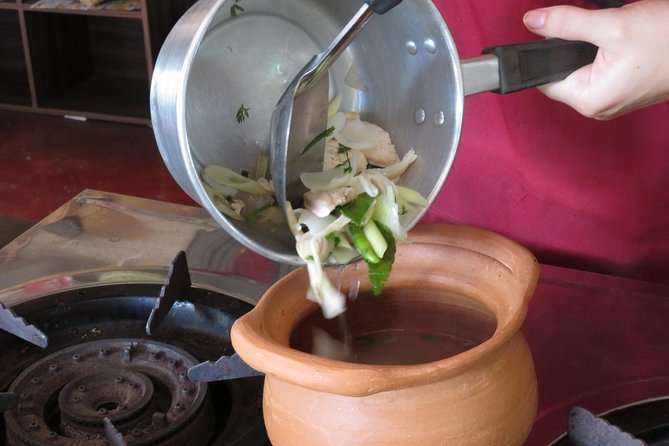
Reviewed · CHIANG MAI THAI COOKING CLASSES
Morning Thai cooking class
Chiang Mai’s best food lesson starts before you reach the stove. At Kad Kom Market, you choose your dishes, shop for the ingredients, and learn to identify Thai vegetables, herbs, and spices. Then you head to Aromdii Cooking School to prepare five dishes from scratch, including a curry paste made by hand.
I like the small eight-person limit, which leaves room for personal help instead of a crowded demonstration. I also like the menu choice: you select one stir-fry, appetizer, soup, curry, and dessert, with several vegetarian-friendly options. The main catch is the heat. The kitchen and dining room have fans, but no air-conditioning, which matters from March through June.
Key points to know before booking
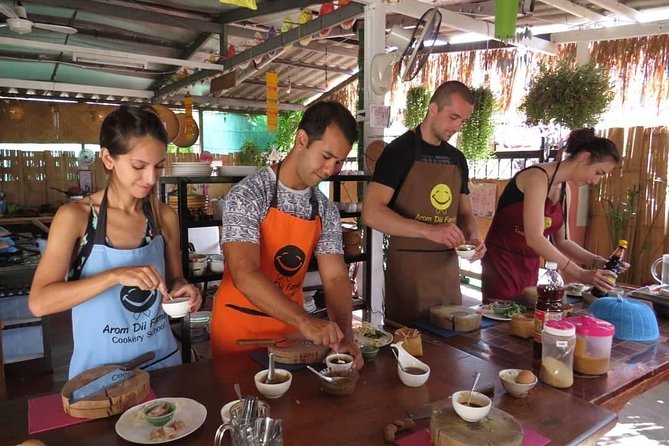
- Five dishes in one morning: Cook a stir-fry, appetizer, soup, curry, and dessert.
- Market first, kitchen second: Spend about 15 to 20 minutes choosing produce and learning about Thai herbs and spices.
- Curry paste made by hand: Khao Soi, green curry, Massaman curry, and red curry are available.
- Small group setting: The class accepts a maximum of eight participants.
- Good menu flexibility: Vegetarian and vegan choices can be accommodated through the broad menu.
- Hot-weather warning: The cooking and eating areas use fans only, not air-conditioning.
Starting at Kad Kom Market at 9:00 am
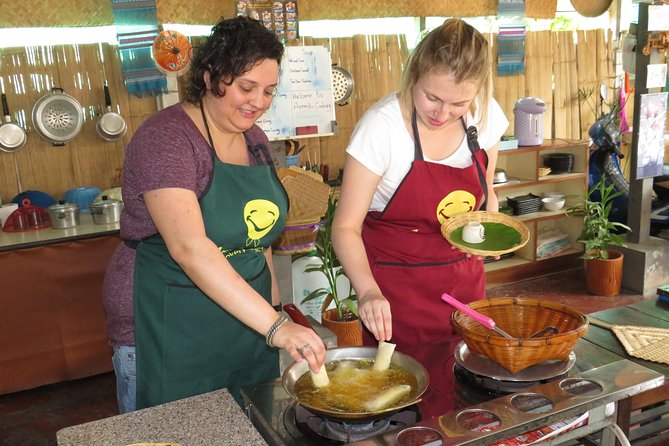
Your morning begins at Kad Kom Market in Chiang Mai’s Chang Khlan area. The stated meeting point is at Kad Kom Market, Ban Lek Tee 19, Moo 3, Wiang Thong 1, Chang Khlan, Chiang Mai 50100. Pickup is available for locations within 3 kilometers of the school, but you should confirm the arrangement when booking if you want transport.
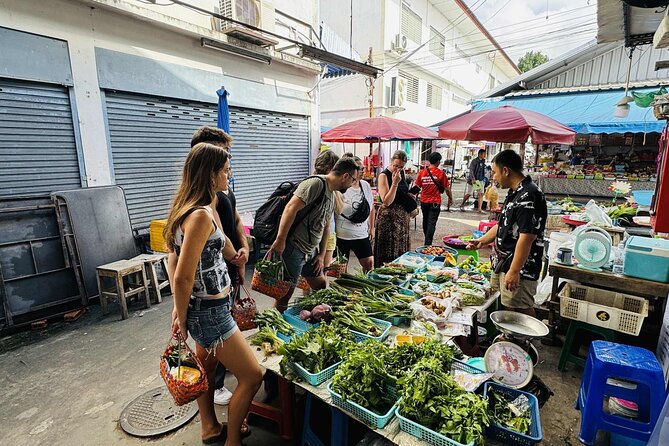
The market visit lasts around 15 to 20 minutes. This is not a long food-market tour, and that is useful to know. It gives you enough time to gather the produce required for your selected dishes without turning the morning into a lecture about every stall.
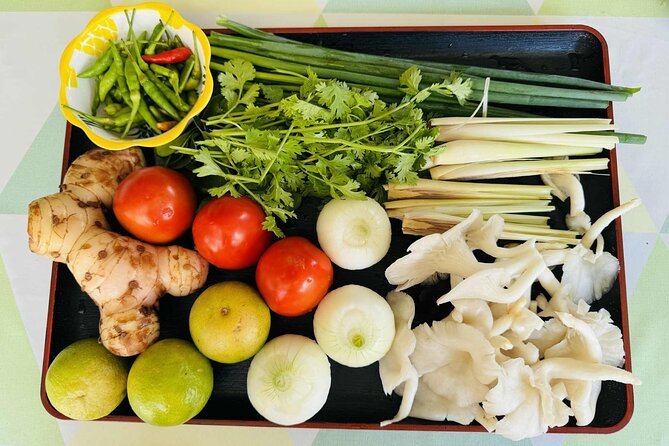
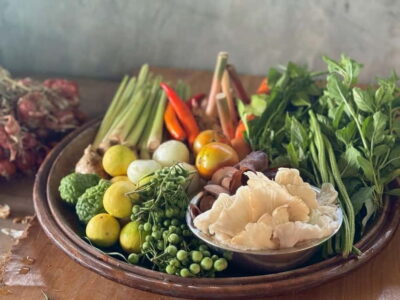
Before class begins, you choose your menu. You then collect the ingredients needed for each dish. The market portion also introduces Thai vegetables, spices, and herbs, and you have time to take photos or buy spices to bring home.
I like this opening because it connects the finished plate to ordinary ingredients. Instead of meeting a tray of measured items in the kitchen, you see what you are about to use in its market setting. If you are curious about Thai food but do not know the difference between the herbs and seasonings, this short stop gives the cooking lesson more context.
Keep your expectations sensible. The market visit is brief, so it will not cover every regional ingredient or explain every Thai cooking tradition. Its main job is practical: choose the menu, find the produce, and get ready to cook.
More Thai Cooking Classes in Chiang Mai:
- Half-Day Thai Cooking Class at Organic Farm in Chiang Mai
★ 5.0 · 19,087 reviews - Chiang Mai: Cooking Class, Market & Thai Herbs Garden Tour
★ 4.9 · 4,824 reviews - Chiang Mai: Authentic Cooking Class with Market & Farm Visit
★ 4.9 · 4,546 reviews
Choosing five dishes from a broad Thai menu
The class is organized around five categories. You pick one item from each, giving you a full meal by the end of the morning.
For the stir-fried dish, you can choose Pad Thai, fried drunken noodles, Pad See Ew, or fried cashew nut. This is a useful spread because the options cover familiar noodles as well as a dish built around cashews. Pad Thai is an easy choice if you want Thailand’s most recognizable noodle dish, while Pad See Ew offers a different noodle style. Fried drunken noodles bring a stronger, spicier direction, although the provided details do not specify how spicy the class makes them.
The appetizer category includes papaya salad, fresh spring rolls, fried spring rolls, and mixed fruit salad. These choices let you decide how much cooking you want in this course. Spring rolls involve preparation and assembly, while a fruit salad is a lighter option. Papaya salad gives you a chance to work with one of Thailand’s best-known fresh dishes.
For soup, the choices are hot and sour prawns thick soup, coconut chicken, Tom Yum chicken, or hot and sour prawns clear soup. The two hot and sour prawn soups are a good comparison for anyone interested in how a clear broth differs from a thicker version. Coconut chicken offers a milder, creamier direction, while Tom Yum chicken keeps the sharp hot and sour profile associated with Thai cooking.
The curry section is the heart of the lesson. You can make Khao Soi, Chiang Mai noodles, green curry, Massaman curry, or red curry. Most important, you make the curry paste from scratch. That step gives you something more useful than simply learning how to stir a prepared paste into a pot. It shows how the flavor base is built before the curry comes together.
Dessert choices are mango sticky rice or pumpkin in coconut milk. Mango sticky rice is the obvious pick if you want a classic Thai dessert, while pumpkin in coconut milk gives you a less common option with a softer, warmer character.
The menu is broad enough to suit different tastes. Vegetarian and vegan options can be accommodated, but the exact combinations depend on your choices. If you follow a strict diet, state that clearly when arranging the booking rather than waiting until the class begins.
From stir-fry to dessert in about four and a half hours
The cooking session lasts approximately 4 hours and 30 minutes. The stated order begins with the stir-fried dish, followed by soup and appetizer, then dessert and curry. That order spreads the work across the morning and gives you several different cooking techniques rather than five versions of the same task.
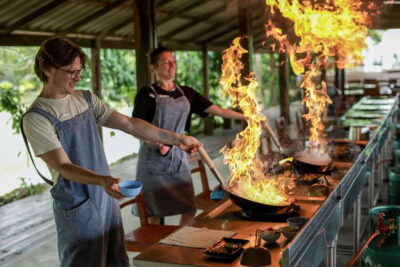
Starting with stir-fry makes sense. You learn how ingredients come together quickly in a hot pan, then move on to dishes that require different handling. Soup lets you work with broth and seasoning, while the appetizer section focuses on fresh preparation, wrapping, or salad-making, depending on your choice.
Dessert comes before curry in the stated schedule. That may seem unusual, but it gives you time to prepare the sweet course before the final savory dish. The curry then finishes the practical lesson with homemade paste and one of the strongest examples of layered Thai flavor.
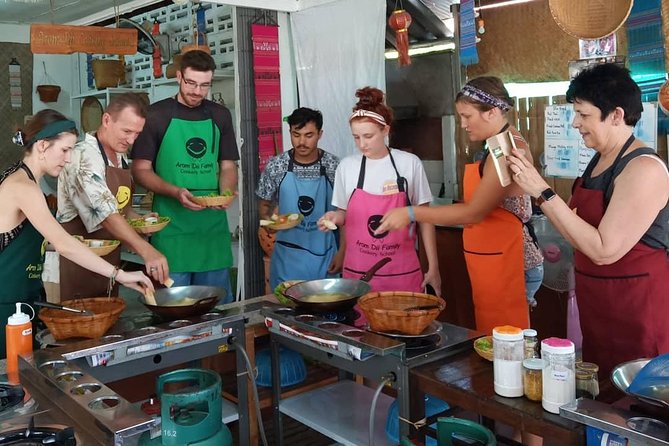
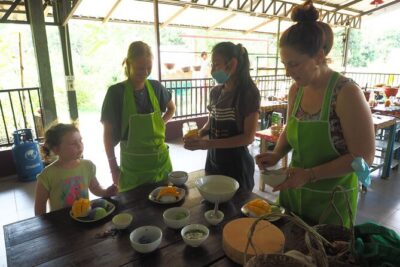
You should expect to do the work yourself rather than watch a chef prepare everything. The class is designed around preparing each selected dish from scratch. The small group of no more than eight makes that format more workable, since there are fewer people competing for attention and kitchen space.
A full five-dish menu is generous for a half-day class. You will not just learn one signature recipe and leave hungry. You also need to consider the pace. Five dishes means a busy morning, and the experience may suit you best if you enjoy an active class rather than a slow, highly detailed lesson on one recipe.
Making curry paste by hand
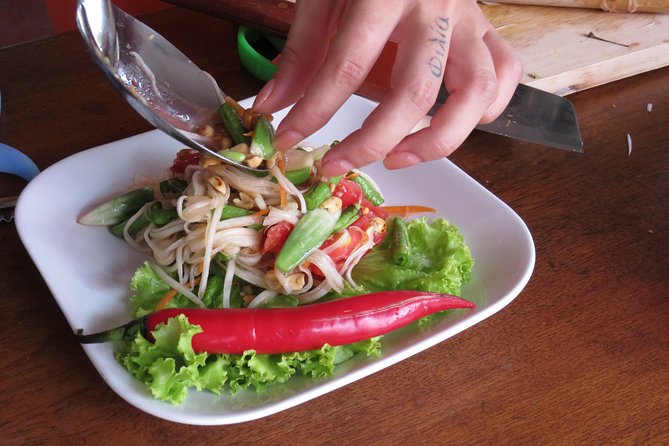
The curry lesson is the most distinctive part of the class. You choose Khao Soi, green curry, Massaman curry, or red curry, then make the curry paste from scratch.
Khao Soi is especially relevant in Chiang Mai. It gives you a local specialty rather than a generic Thai restaurant staple. Green, Massaman, and red curry let you choose among other well-known Thai styles, but Khao Soi connects the cooking experience to the city where you are taking the class.
Making paste yourself also helps you understand why Thai curry tastes so different from a quick home version made with a jar. The supplied details do not list the exact ingredients or equipment, so I would not book this expecting a formal lesson on every spice or a written explanation of regional curry history. You will, however, work through the paste as part of the dish, which gives the curry section real value.
You receive a handmade recipe download from the school’s website. That matters because five dishes can be hard to remember after a full morning of cooking. The digital recipes give you a way to recreate at least some of the meal at home, assuming you can find the required ingredients.
A different kind of day out of Chiang Mai altogether:
- Chiang Mai: Elephant Sanctuary, Waterfall & Bamboo Rafting
★ 4.9 · 9,160 reviews - Chiang Mai: Doi Inthanon National Park Eco-Friendly Tour
★ 4.6 · 6,667 reviews - Chiang Mai: Elephant Sanctuary & Waterfall Group Tour
★ 4.9 · 5,780 reviews - Chiang Mai: Chiang Rai Temples, Karen Tribe and Hot Springs
★ 4.7 · 5,401 reviews
The no-air-conditioning setup
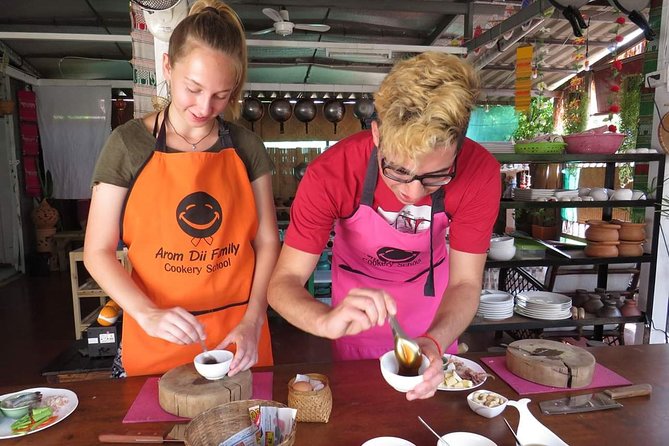
The cooking school has no air-conditioning in either the kitchen or eating room. Fans are provided, but this remains a warm-weather activity, especially during March, April, May, and June.
The class also operates during the rainy season from July through October and the winter season from November through February. The cooler months are likely to be more comfortable, though the supplied information does not promise a particular temperature or indoor climate.
I would treat the fan-only setup as the main practical drawback. Cooking already creates heat, and a long morning in a warm kitchen can feel tiring. Wear light clothing, bring water, and avoid packing the morning too tightly with another demanding activity. Bottled water and seasonal fruit are included, which helps, but the room will not feel cool.
The weather also affects operation. The experience requires good weather, and poor conditions can lead to a different date or a full refund. That policy is especially relevant in Chiang Mai’s rainy period.
What the $27.70 price includes
At $27.70 per person, this is a strong-value half-day activity if you want both instruction and a full meal. The price covers the market component, cooking class, bottled water, seasonal fruit, recipe download, and transportation for nearby locations within 3 kilometers.
The value comes from the amount of food you prepare. One stir-fry, one appetizer, one soup, one curry, and one dessert is a much fuller cooking experience than a short lesson focused on a single dish. The market stop adds another useful layer, even though it is brief.
Transport has limits. Pickup is included only for nearby locations within 3 kilometers, so you should not assume that any hotel in Chiang Mai is covered. The class starts and ends at the meeting point, and nearby public transportation is available.
The class has a maximum of eight participants. A small group does not automatically guarantee perfect instruction, but it gives the teacher a better chance to offer individual comments. For a cooking class, that personal space is worth more than a larger session priced only slightly lower.
The experience is also booked about 21 days ahead on average. That does not mean you must reserve three weeks in advance, but it is a useful warning for busy travel dates. If you know you want a morning class, book early enough to avoid having to rearrange your Chiang Mai schedule.
Who will get the most from this class
I would recommend this class to first-time visitors who want a practical introduction to Thai food, especially anyone who prefers cooking over a standard restaurant meal. The choice of five dishes lets you sample several parts of the cuisine in one morning.
It also suits couples, friends, and solo participants who like a social class. The eight-person limit keeps the group small enough for a friendly working atmosphere and personal comments. A French-language review described the organization and good mood positively, noting that a group of eight still allowed personal feedback. That is a useful sign for anyone who worries that a group class will feel impersonal.
Vegetarians and vegans have a fair amount of menu flexibility. The information specifically says the menu can accommodate both, but you should make your dietary needs clear in advance so the selected dishes can be handled properly.
I would be more cautious if you dislike heat, need air-conditioning, or want a quiet, slow lesson focused on one dish. This is a full morning with five recipes, not a short demonstration. It may also be less suitable for anyone who wants extensive market exploration, since the market portion is only around 15 to 20 minutes.
Practical details for a smooth morning
The experience begins at 9:00 am and returns to the same meeting point. The activity lasts about 4 hours and 30 minutes, so you should expect to finish in the early afternoon.
A mobile ticket is accepted, and confirmation is provided when you book. Only booked participants may join, with no space reserved for visitors. The group limit is eight.
Free cancellation is available if you cancel at least 24 hours before the local start time. Cancellations or changes made inside that 24-hour window are not refunded or accepted. If the minimum number is not reached, the provider offers another date or experience, or a full refund.
Because the class may be canceled for poor weather, keep your schedule flexible if you book during the rainy season. The school also requires a minimum number of participants, so the final arrangement can depend on that condition.
Should you book Aromdii Cooking School?
Book this experience if you want a hands-on Chiang Mai cooking morning with a market visit, five dishes, and homemade curry paste at a reasonable price. The best reasons to choose it are the eight-person limit, the broad menu, and the chance to make Khao Soi or another curry from its paste upward.
Skip it if air-conditioning is important to you, or if you want a long, detailed market tour. For most food-focused visitors, though, the balance is good: you shop for ingredients, cook a complete Thai meal, eat what you make, and leave with recipes you can try again at home.
FAQ
Where does the cooking class begin?
It begins at Kad Kom Market, Ban Lek Tee 19, Moo 3, Wiang Thong 1, Chang Khlan, Chiang Mai 50100, Thailand.
What time does the experience start?
The class starts at 9:00 am.
How long does the experience last?
The full activity lasts approximately 4 hours and 30 minutes.
Does the class include a market visit?
Yes. The market portion lasts about 15 to 20 minutes. You choose your dishes, collect the needed produce, learn about Thai vegetables, spices, and herbs, and have time to take photos or buy spices.
How many dishes will I cook?
You will choose and prepare five dishes: one stir-fried dish, one appetizer, one soup, one curry, and one dessert.
Can I choose my own menu?
Yes. The menu includes several choices in each of the five categories, including Pad Thai, spring rolls, Tom Yum chicken, Khao Soi, green curry, mango sticky rice, and other options.
Are vegetarian and vegan options available?
Yes. The menu can accommodate vegan and vegetarian choices. You should state your dietary needs when booking.
Is transportation included?
Transportation is included for nearby locations within 3 kilometers of the cooking school. The activity begins and ends at the stated meeting point.
Does the cooking school have air-conditioning?
No. The kitchen and eating room have fans only. There is no air-conditioning.
More Early Starts in Chiang Mai
- Chiang Mai: Doi Suthep, Wat Umong, and Pha Lat Sunrise Tour
★ 4.7 · 1,425 reviews - Wat Phra That Doi Suthep spiritual Sunrise Tour with an Ex-monk
★ 5.0 · 798 reviews - Spiritual Sunrise Wat Doi Suthep, Pha Lat, Alms & Meditation
★ 4.9 · 674 reviews - Half Day Morning Wat Pha Lat & Wat Phra That Doi Suthep Tour
★ 4.8 · 269 reviews
More Hands-On Classes in Chiang Mai
- Thai and Akha Cooking Class in Chiang Mai
★ 5.0 · 4,358 reviews - Chiang Mai: Cooking Class with Market and Pickup
★ 4.9 · 1,365 reviews - Chiang Mai: Cooking Class with Organic Farm at Mama Noi
★ 4.9 · 1,151 reviews - Chiang Mai: Evening Cooking Class and Local Market Visit
★ 4.9 · 648 reviews
Newly reviewed around Chiang Mai
- Workshop Making Herbal ball & herbal inhaler★ 4.3 · 3 reviews
- Chiang Mai Zipline White Water Rafting and Elephant Sanctuary★ 4.0 · 11 reviews
- Walk With Monks Collecting Alms(meeting point maybe change)★ 4.9 · 8 reviews
- Trek to a Jungle Waterfall★ 5.0 · 14 reviews
- Zipline+Sticky waterfall+Long Neck Village Private Tour★ 5.0 · 22 reviews
- Meditation Retreat and Self-Care in Nature★ 5.0 · 4 reviews
- Full Day Yoga, Meditation, and Thai Cultural Immersion in Chiang Mai★ 5.0 · 3 reviews
- Long Neck Village, White & Blue Temple, Black House Day Tour From Chiang Mai★ 4.0 · 14 reviews
Chiang Mai Thai Cooking Classes, compared.
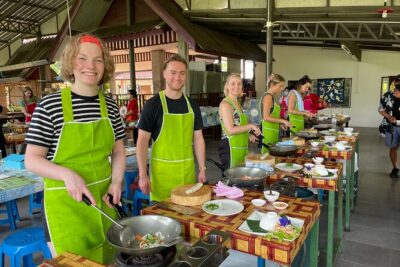
Half-Day Thai Cooking Class at Organic Farm in Chiang Mai
Read our review →
Cooking Class, Market & Thai Herbs Garden Tour
Read our review →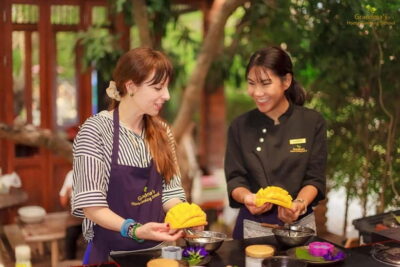
Authentic Cooking Class with Market & Farm Visit
Read our review →
Browse the lists this tour appears in