
Reviewed · CHIANG MAI CYCLING TOURS
Colors of Chiang Mai Guided Bicycle Tour
Chiang Mai’s best bicycle riding often begins where the city’s traffic thins out. This half-day route takes you through leafy lanes, rice fields, fruit orchards, local communities, and the old settlement of Wiang Kum Kam, with a stop at a 700-year-old Chedi along the way.
I like the easy pace and the way the guides handle crossings, especially if you are not keen on busy roads. I also like the local stops: women making Thai products, a market snack or fresh fruit, a riverside ride, and a plate of Khao Soy Kai at a small local restaurant. The main consideration is distance. You cover about 20 to 25 kilometers, and the exact route can change when fields, shops, or schools are closed.
Key points at a glance
- Quiet countryside riding: Most of the route uses green lanes and calm local roads rather than major city streets.
- Guides who add context: Guides such as Wit, Wee, Dong, and Koi have been praised for patience, clear hand signals, and useful explanations.
- A useful history stop: Wiang Kum Kam was founded in 1286 and served as the Lanna capital for about 10 years.
- Local food included: The tour includes water or soft drinks and a Thai snack or meal, often Khao Soy Kai.
- A manageable but real ride: Plan for roughly 20 to 25 kilometers over 270 minutes, usually at an easy pace.
- Plans can shift: Rice fields and orchards change with the season, and local markets or shops may not open every day.
Why this ride shows you a quieter Chiang Mai
The tour begins by leaving the city’s main sights behind. Instead of spending the morning moving between traffic lights and famous temple gates, you pedal through smaller communities where the day unfolds at a slower pace.
You pass homes, local businesses, planted fields, and narrow roads shaded by trees. The route is not designed as a hard cycling challenge. It is a sightseeing ride, with regular pauses for temples, food, photographs, and explanations from your guide.
That makes it a good choice if you want to see how Chiang Mai works outside the old city walls. You get a look at ordinary surroundings without giving up the comfort of a planned route, a supplied bicycle, and a guide who knows where the busier crossings are.
The experience is listed at $38 per person. For that price, you receive a bicycle, helmet, English-speaking guide, drinks, insurance, and a Thai meal or snack. You also get nearly four and a half hours of structured sightseeing. I consider that fair value, especially because the food and guide are included rather than added as small extras during the ride.
More Bike Tours in Chiang Mai:
- Chiang Mai: Historic Old City Bike Tour – Morning or Night
★ 4.7 · 263 reviews - Chiang mai Hike & Downhill Bike Adventure –Suthep National Park
★ 4.5 · 204 reviews - Chiang Mai: Historic Old City Bike Tour – Morning or Night
★ 5.0 · 202 reviews
Starting with temples and local communities
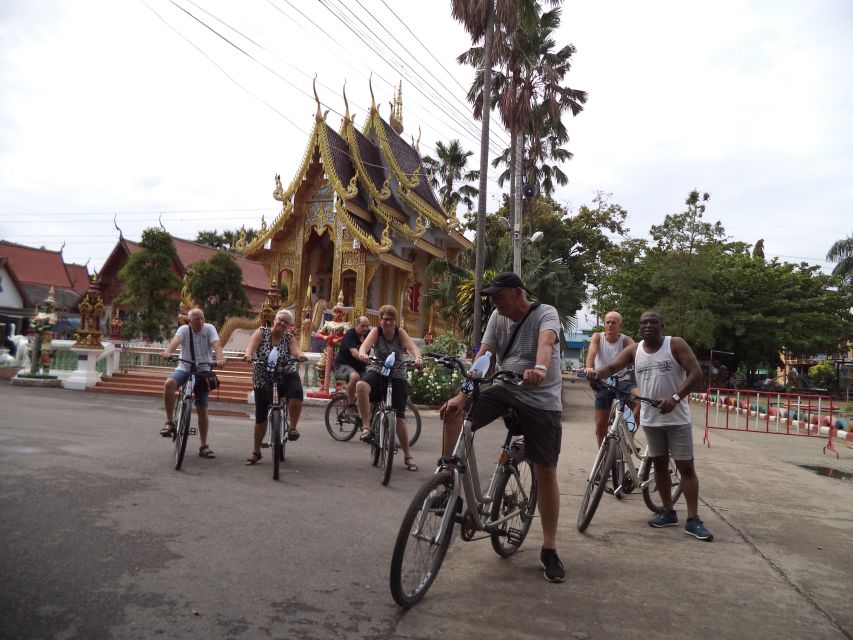
One of the first useful stops is a local temple. Your guide explains the temple and basic Buddhist traditions, giving you more than a quick photograph before getting back on the bike.
This is where the guide can make a real difference. Wit, also spelled Weet in one account, has experience as a former monk and has explained Buddhist customs from personal experience. Guides including Wee and Dong have also been praised for answering questions and explaining local traditions in a clear, friendly way.
You should not expect a long formal lecture. The strength of the stop is its setting. You are seeing a working local place of worship during a ride through nearby communities, not simply checking another famous monument off a list.
Dress and behave respectfully at the temple. The supplied information does not specify a dress code, but modest clothing is a sensible choice for any Thai temple visit.
The route may also include stops connected with local production. The tour description highlights women making traditional Thai products, while past outings have included pottery making and an explanation of how coffee beans are roasted in a furnace. Exact stops can vary, so think of this as a chance to see local work rather than a guaranteed demonstration of one particular craft.
Rice fields, orchards, and a market snack
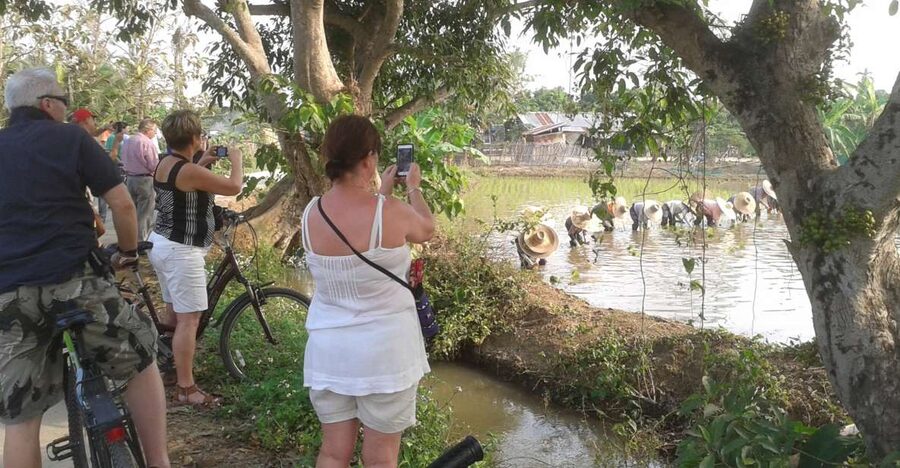
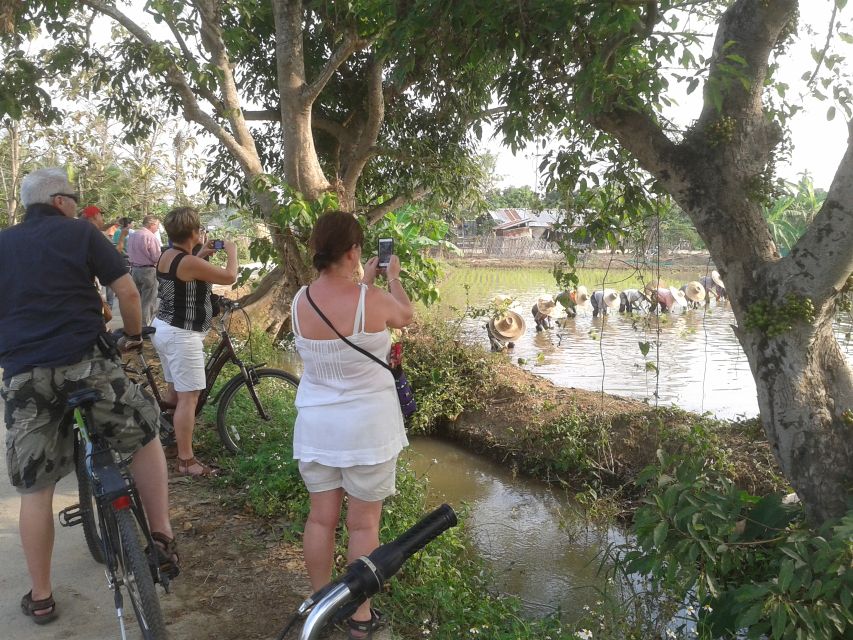
After the temple, the ride reaches open areas with rice fields and fruit orchards. These sections give you a pleasant break from built-up Chiang Mai, but the scenery is seasonal.
Rice fields and orchards do not look the same throughout the year. Fields may be green at one time and recently harvested at another, and the operator can alter the route when crops are not in season. The same applies to local shops and schools, which may close during weekends, school breaks, or national holidays.
A market stop adds a taste of daily life. You may have fresh fruit or a small Thai snack, depending on the day and route. One outing included a Saturday market, with the clear warning that it does not operate every day.
That detail matters. If a market is central to your expectations, this may not be the right tour to book for that one feature. If you see it as a pleasant bonus, the changing schedule is less of a concern.
The food stops are one of the better parts of the experience because they break up the cycling naturally. You can rest, drink, ask questions, and try something local rather than carrying on for several hours without a pause.
Following the Ping River
The ride along the Ping River is less about a single famous viewpoint and more about atmosphere. You pedal beside one of the waterways that helps define Chiang Mai, passing small settlements and green spaces close to the city.
The river section also gives you a useful sense of scale. Chiang Mai is not only a compact old town surrounded by restaurants and guesthouses. It spreads into quieter communities where the pace and surroundings feel different from the central streets.
Several guides have been praised for keeping the ride calm and safe. One guide used clear hand signals and took care at crossings. Another helped a rider who was uneasy on busy roads feel more comfortable. Most of the route uses quiet or leafy roads, but you should still be ready for occasional traffic and road crossings.
This is not a traffic-free cycle path. You need normal road awareness, and you should follow the guide closely when the group reaches a busier street. The positive point is that the ride is planned around calmer roads wherever possible.
More Guided Days in Chiang Mai:
- Chiang Mai: 3 Hour Old City and Temples Guided Walking Tour
★ 4.6 · 1,568 reviews - Chiang Mai: Doi Inthanon Trip with Pha Dok Siew Guided Trek
★ 4.6 · 910 reviews - Chiang Mai: Historic Temples and City Guided Walking Tour
★ 4.7 · 650 reviews - Chiang Mai: Local Food and Markets Guided Walking Tour
★ 4.3 · 175 reviews
Wiang Kum Kam and the 700-year-old Chedi
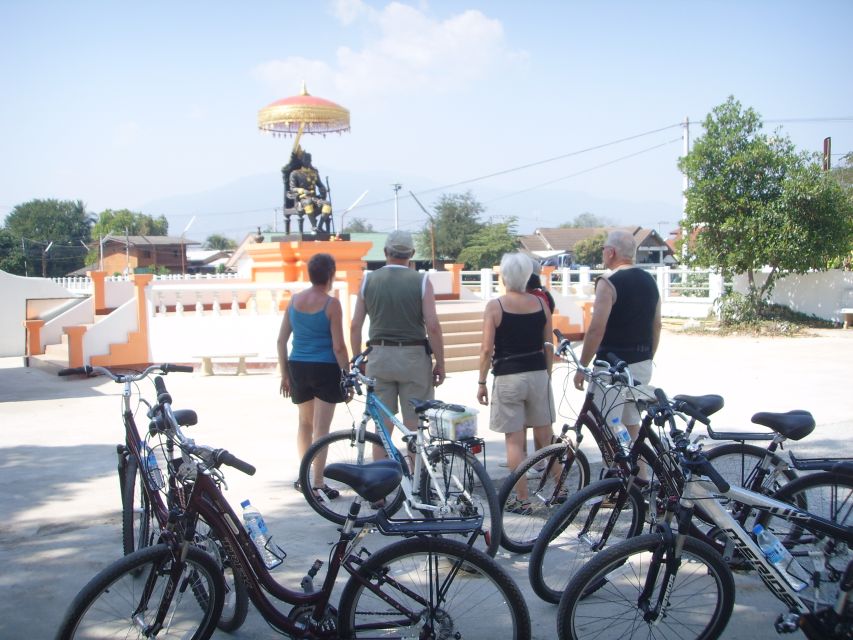
The final major section reaches Wiang Kum Kam, an old settlement founded in 1286 by King Mengrai. It served as the capital of the Lanna Empire for about 10 years before the capital moved elsewhere.
Today, the area contains temples and ruins dating back hundreds of years. Cycling between the sites makes the visit feel different from arriving by car, stopping at one monument, and leaving again. You see the remains as part of a wider historic area, with the countryside still close by.
The advertised highlights include a 700-year-old Chedi. This is the kind of stop that gives the ride a strong historical finish, especially after the morning has focused on village life, food, and farming.
You have time to stop and take photographs before cycling back to the starting point. The tour does not present Wiang Kum Kam as a vast archaeological park requiring a full day. Instead, it fits several ruins into a wider half-day outing.
That balance is useful. You get genuine historical interest without giving up the local food and countryside sections that make this tour different from a standard temple circuit.
What the guides add to the ride
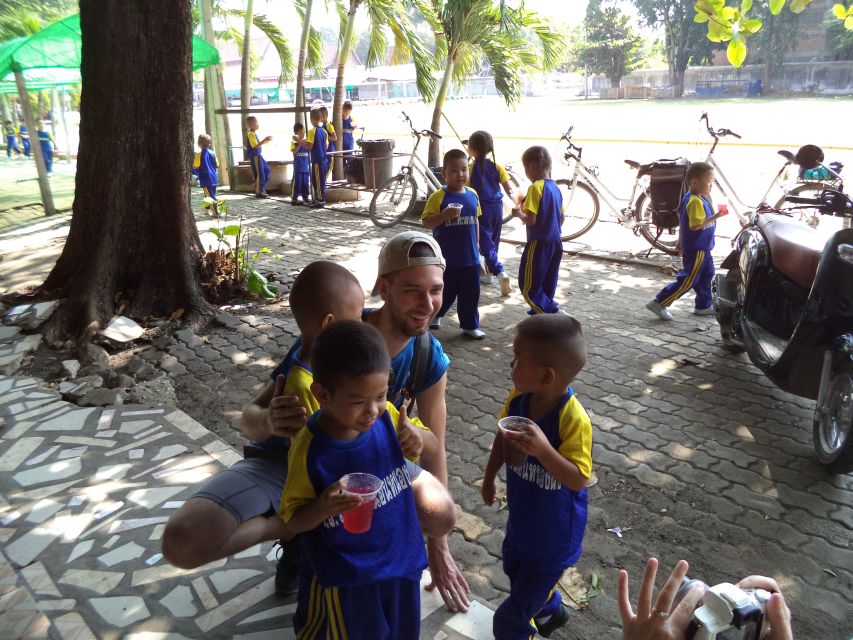
The strongest part of this experience is the guiding. Names that appear in the tour feedback include Wit or Weet, Wee, Dong, Koi, and Wichan. You may not receive one of those particular guides, but the repeated strengths are clear: patience, local knowledge, kindness, and attention to road safety.
Wee has been praised for looking after a group and keeping a sensible pace. Wit has been described as funny, patient, and able to answer questions about food, temples, and places to visit elsewhere in Thailand. Dong has been associated with leafy suburban roads and explanations of local culture.
Those details matter more than a polished script. A good cycling guide needs to do several jobs at once: point out sights, manage crossings, watch the group, adjust the speed, and create enough pauses for you to enjoy the ride.
The ride has also worked well for people who do not consider themselves serious cyclists. One outing covered about 20 kilometers in three to four hours, and the riders felt the time passed quickly. Another followed a mostly easy route on quiet roads.
Still, do not treat 20 to 25 kilometers as nothing. You should be comfortable sitting on a bicycle for several hours and riding on public roads. The pace may be relaxed, but the distance remains real.
Food, drinks, and the value of the included meal
The tour includes water or soft drinks and a Thai meal or snack. The meal may be Khao Soy Kai, Chiang Mai’s well-known chicken curry noodle dish, served at a local restaurant.
That is a useful inclusion at the $38 price point. You are not only paying for a bicycle and a guide. You also avoid having to search for lunch while keeping track of a group and a route.
The food experience is informal. Past stops have included a small local eatery, fresh fruit, ice cream, coffee, and a roadside restaurant. The exact combination can vary, but you should expect simple local food rather than a formal dining experience.
If you have dietary restrictions, ask before booking. The supplied information does not list vegetarian, vegan, allergy, or halal arrangements, so do not assume the included Khao Soy Kai can be changed.
Timing, group size, and practical details
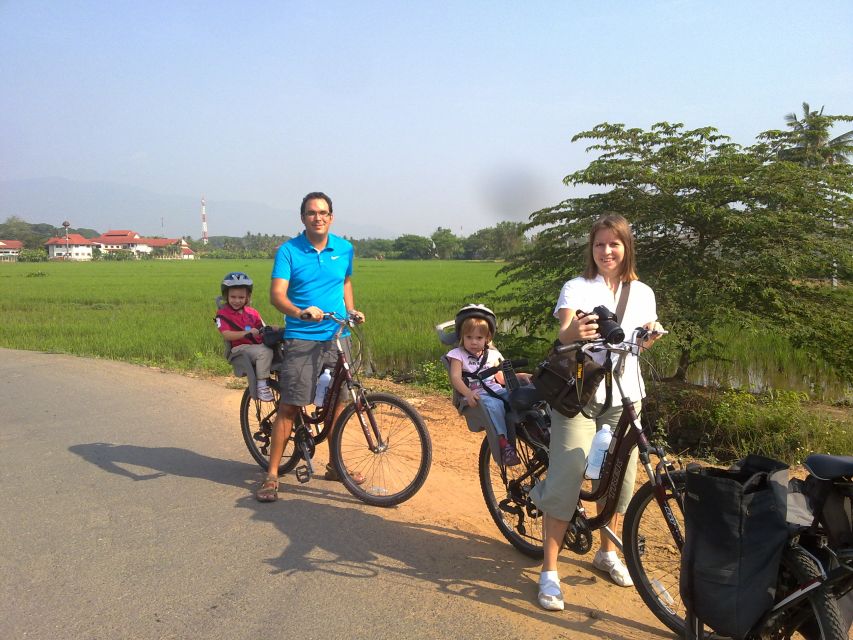
The advertised duration is 270 minutes, or four and a half hours. The route covers approximately 20 to 25 kilometers, though exact distance and stops can change.
You should arrive at the meeting point five to 10 minutes before departure. Bicycle, helmet, guide, insurance, and refreshments are included. Free WiFi is available at the operator’s office.
Private and small-group options are available. This can be helpful if you prefer a quieter ride or want the guide to adjust the pace around your group. The available languages are English and Thai.
Solo riders are welcome, but the tour requires at least two participants to operate. If that minimum is not reached, the operator may offer another time, day, or tour, or cancel the booking.
The activity offers free cancellation up to 24 hours before departure and allows you to reserve now and pay later. Those terms are useful if your Chiang Mai plans are still changing.
One practical transport note comes from a past outing: a tuk-tuk was arranged for the group to return to the city at 50 baht per person. Do not treat that as a guaranteed part of every departure, since it is not listed among the standard inclusions, but it shows that the operator may help when the return proves inconvenient.
Who will enjoy this Chiang Mai bicycle tour
I would choose this tour if you want a look at Chiang Mai beyond the old city, especially if temples alone are not enough for you. It combines countryside, food, riverside riding, village activity, and history in one morning or afternoon.
It suits:
- Casual cyclists who can manage 20 to 25 kilometers at an easy pace
- People who want help handling busier crossings
- Visitors interested in local food and small-scale craft work
- First-time visitors who want context from an English-speaking guide
- Couples, families, solo riders, and small groups who prefer a guided outing
- Anyone looking for a break from the city streets
I would be more cautious if you dislike cycling for several hours, need a completely traffic-free path, or want a fixed itinerary with guaranteed market and orchard conditions.
The route also depends on the calendar. A Saturday market may be open on one day and absent on another. Schools and local shops may close during weekends, holidays, and school breaks. The operator can change the route when rice fields and fruit orchards are not in season.
Should you book the Colors of Chiang Mai tour?
Book it if you want an active, easy-paced introduction to Chiang Mai’s outer communities and you value a guide who can connect food, Buddhism, local work, and history.
The best reasons to go are the calm roads, careful guiding, included Thai food, Ping River section, and Wiang Kum Kam ruins. The main tradeoff is that the ride is long enough to require basic cycling comfort, and some stops depend on the season or day of the week.
At $38, I see good value in the mix of transport, guiding, refreshments, food, insurance, and nearly half a day of sightseeing. This is not the tour for ticking off every major temple in central Chiang Mai. It is the better choice if you want to pedal through quieter places and see how local life continues just outside the city.
FAQ
How long is the Colors of Chiang Mai bicycle tour?
The tour lasts 270 minutes, or about four and a half hours.
How far do you cycle?
The route covers approximately 20 to 25 kilometers.
What type of roads does the tour use?
The route mainly uses quiet, green land roads, leafy local roads, and some roads near communities. You may also cross busier roads with the guide’s assistance.
Is a bicycle provided?
Yes. The bicycle and bicycle helmet are included.
Is food included?
Yes. The tour includes a Thai meal or snack. The meal may include Khao Soy Kai at a local restaurant, depending on the route.
Are drinks included?
Yes. Water or soft drinks are provided during the excursion.
Which languages are available?
The tour is offered with a live guide in English or Thai.
Can solo travelers join?
Solo travelers are welcome, but the tour operates with a minimum of two participants.
What happens if the minimum group size is not reached?
The operator may offer another time, day, or tour, or cancel the reservation.
Can the itinerary change?
Yes. The route may change because rice fields and fruit orchards are seasonal, and schools, markets, or local shops may be closed on weekends, holidays, or school breaks.
Newly reviewed around Chiang Mai
- Workshop Making Herbal ball & herbal inhaler★ 4.3 · 3 reviews
- Chiang Mai Zipline White Water Rafting and Elephant Sanctuary★ 4.0 · 11 reviews
- Walk With Monks Collecting Alms(meeting point maybe change)★ 4.9 · 8 reviews
- Trek to a Jungle Waterfall★ 5.0 · 14 reviews
- Zipline+Sticky waterfall+Long Neck Village Private Tour★ 5.0 · 22 reviews
- Meditation Retreat and Self-Care in Nature★ 5.0 · 4 reviews
- Full Day Yoga, Meditation, and Thai Cultural Immersion in Chiang Mai★ 5.0 · 3 reviews
- Long Neck Village, White & Blue Temple, Black House Day Tour From Chiang Mai★ 4.0 · 14 reviews
Chiang Mai Cycling Tours, compared.
Chiang mai Hike & Downhill Bike Adventure –Suthep National Park
Read our review →
Half-day E-bike Nam Phrae (hilly, fully paved roads, GUIDED)
Read our review →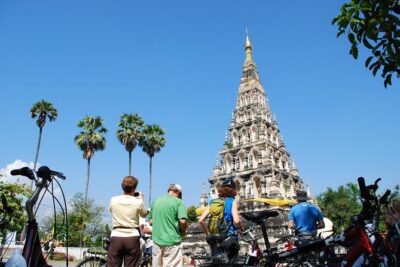
Half-day E-bike Countryside and rice paddies (flat land, GUIDED)
Read our review →Browse the lists this tour appears in