
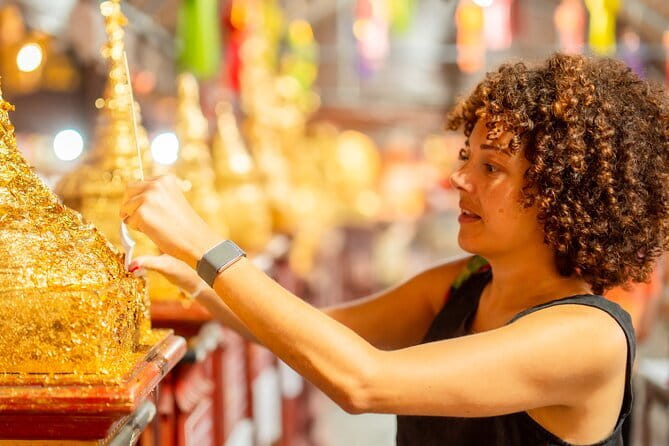
Reviewed · CHIANG MAI OLD CITY WALKING TOURS
Old Town History and Culture Walking Tour at Chiang Mai
Chiang Mai’s story comes into focus on foot, beginning with King Mangrai at the Three Kings Monument and continuing through two of the old town’s most important temples. I like the compact route and the chance to hear about Lanna culture while standing in the places where it developed. I also like that the group is capped at eight, so questions should be easier than on a large bus tour.
The price is a modest $15, and it includes temple entrance fees, bottled water, insurance, and an English-speaking guide. The main drawback is that the experience depends heavily on the guide’s English and presentation. One poor report describes repeated explanations and hard-to-follow communication, so guide quality may not be perfectly consistent.
Key points at a glance
- Three Kings Monument start: Learn about King Mangrai and Chiang Mai’s founding before walking into the old town.
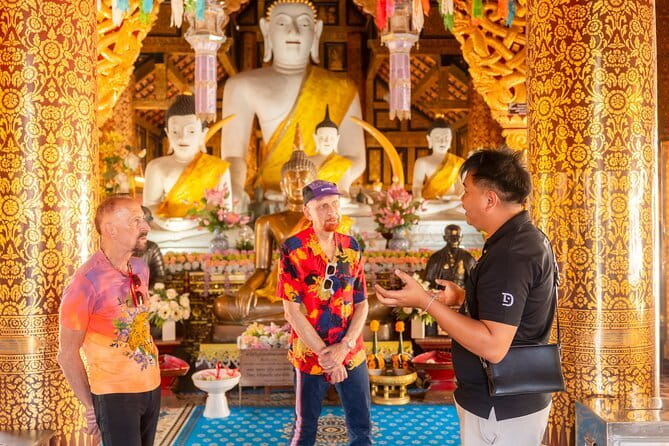
- Wat Phra Singh: Spend an hour with Lanna architecture, the Lai Kam assembly hall, murals, and a pagoda linked to the Year of the Dragon.
- Wat Chedi Luang finish: See a 600-year-old temple complex and hear about its importance in Chiang Mai’s past.
- Small group size: The tour accepts no more than eight participants, a useful limit for temple visits and questions.
- Cultural choice: You may be asked if you want a monk’s blessing, with no pressure to take part.
- Strong overall value: At $15, included admission fees make this an inexpensive introduction to Chiang Mai’s old town.
Why this short walk works in Chiang Mai
Chiang Mai can feel confusing at first. Its old town is laid out in a square, but the history inside that square is layered and not always obvious from the street. A guided walk gives you a simple thread to follow: the founding of the Lanna Kingdom, the growth of Chiang Mai, and the role of Buddhism in daily life.
This tour lasts about two and a half hours. That is long enough to visit two major temple complexes without turning the morning or afternoon into a full-day commitment. You walk between the stops rather than sit in a vehicle, which helps you notice the scale of the old town and the way temples sit alongside ordinary streets.
I especially like the small-group limit of eight. A guide can usually speak to everyone without shouting, and you have a better chance to ask about details that catch your eye. The route is also easy to understand: meet at the Three Kings Monument, visit Wat Phra Singh, then continue to Wat Chedi Luang, where the tour ends.
The published rating is 4.8 out of 5, with 92 percent of participants recommending the experience. That is a strong result, though the small total of 13 ratings means you should not treat the number as a guarantee. The most praised features are the guides’ friendliness, clear explanations, good pacing, and the value of having entrance fees included.
More Old City Walking Tours in Chiang Mai:
- Chiang Mai: 3 Hour Old City and Temples Guided Walking Tour
★ 4.6 · 1,568 reviews - Chiang Mai: Historic Old City Bike Tour – Morning or Night
★ 4.7 · 263 reviews - Chiang Mai: Historic Old City Bike Tour – Morning or Night
★ 5.0 · 202 reviews
Starting with King Mangrai at the Three Kings Monument
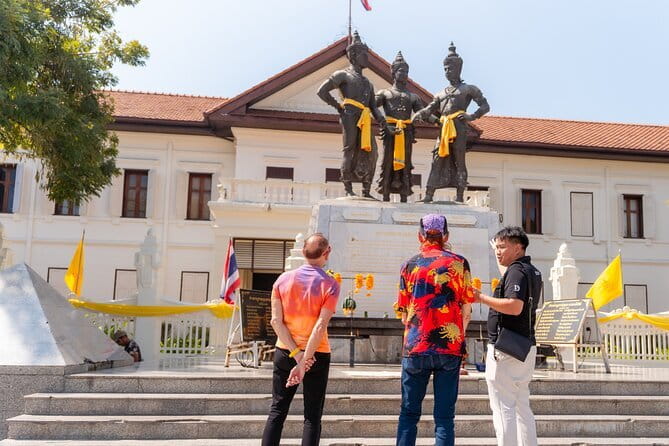
The meeting point is the Three Kings Monument on Prapokklao Road. This is a practical place to begin because it sits in the center of Chiang Mai’s old town and is near public transportation.
The opening talk covers the monument and King Mangrai, who appears in the middle of the three figures. Mangrai was the first king of the Lanna Kingdom and the founder of Chiang Mai. Knowing that before entering the temples helps you see them as part of a kingdom’s religious and political center, not simply as attractive buildings.
You also receive a safety briefing at the start. That may sound routine, but it is useful on a walking tour in a busy town. The guide can set expectations for the route, explain how the group will move, and make sure everyone knows where the walk begins.
The stop lasts about 30 minutes and has no admission charge. It is more than a photo stop, but it is still an introduction rather than a long lecture. If you already know Chiang Mai’s basic history, you may find this part familiar. If you are new to the city, it gives you the dates and names needed to make sense of the temples ahead.
Wat Phra Singh and the details of Lanna design
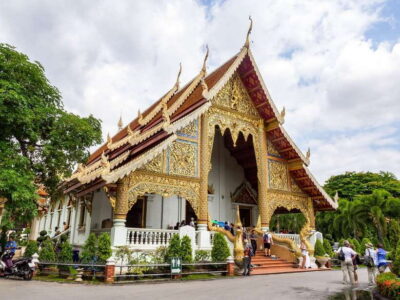
After the monument, the group walks to Wat Phra Singh. This temple dates to 1346 and is described as the second most important temple in Chiang Mai. You spend about an hour here, with admission included.
The main reason to pay attention is the temple’s Lanna design. Lanna was the northern Thai kingdom centered around Chiang Mai, and its artistic style has a look of its own. Your guide can point out features that are easy to miss if you simply wander through, especially the proportions of the buildings, the decoration, and the relationship between the assembly hall and pagoda.
The Lai Kam assembly hall is a key part of the visit. Its murals are among the most important visual details on the route. Instead of rushing through for a few photographs, take time to look at the scenes and ask what they show. The guide’s explanation can help connect the artwork to Buddhist ideas and local culture.
The pagoda also has a special connection for people born in the Year of the Dragon. That detail gives the stop a personal angle. If you or someone in your group was born under that sign, you may find the visit especially meaningful. Even if you were not, it is a good example of how astrology, religious practice, and temple tradition can overlap.
Wat Phra Singh is also the point where the guide’s strengths matter most. A good explanation turns murals and architecture into a story. A weak explanation leaves you with pretty buildings but little reason to remember them. Guides connected with this tour include Kitty and Khun Bim. Khun Bim has been praised for excellent English and thoughtful explanations of Thai Theravada Buddhism, while Kitty has also led the walk. Guide assignments can change, so do not book solely on the hope of receiving one particular person.
Remember that this is an active religious site. Dress and behave respectfully, and listen when the guide explains local temple customs. The tour includes admission, which keeps you from handling separate entry payments during the walk.
The short walk to Wat Chedi Luang
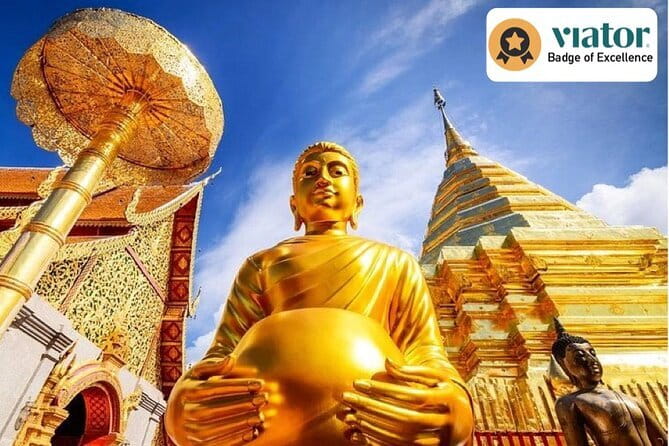
From Wat Phra Singh, the route continues on foot to Wat Chedi Luang Varavihara. The walk is short enough to keep the tour moving, and the change of location gives you a chance to shift from the refined details of Wat Phra Singh to the more imposing ruins of the next complex.
Wat Chedi Luang dates to the 14th century and is best known for the remains of a large chedi. The site carries a stronger sense of age and damage than Wat Phra Singh. Rather than seeing one complete architectural design, you see a complex shaped by time, restoration, and changing religious use.
The temple was restored by UNESCO in the 1990s, according to the tour information. That detail matters because the site you see today is not simply untouched old stone. It is also the result of careful work intended to preserve Chiang Mai’s historic center.
You have about an hour here. That gives the guide room to explain the temple’s place in the city and to point out the parts that deserve a closer look. The complex is popular with local people and international visitors, so the small group helps keep the experience more personal.
One of the most distinctive features is the chance to speak with monks. This is not presented as a formal religious obligation. You may also be asked if you want to receive a monk’s blessing for good luck. I appreciate that the choice is raised clearly, since not everyone wants to take part in a practice from another religion. You can listen, ask questions, or decline respectfully.
The tour ends at Wat Chedi Luang. That is useful if you want to continue exploring the temple afterward or make your own way to another old town sight. It also means there is no return transfer to your hotel, so you should plan your next step from the temple.
More Heritage Days in Chiang Mai:
- Chiang Mai: Historic Temples and City Guided Walking Tour
★ 4.7 · 650 reviews - Chiang Mai: Private Historic Old City Bike Tour – Night
★ 4.7 · 143 reviews - Chiang Mai: Historical and Culture Exploration Walking Tour
★ 4.6 · 40 reviews - 1 Day Sukhothai Historical Park from Chiang Mai Private Tour
★ 5.0 · 29 reviews
What the guide adds, and where the tour can falter
The best reason to book this walk is not transportation. You can reach these sites on your own. The value comes from having someone explain what you are seeing and connect three separate locations into one story.
The strongest guide feedback points to friendly delivery, clear English, good timing, and a useful balance of detail. One particularly positive account describes learning more about Thai Theravada Buddhism even after many years of studying another Buddhist tradition. That suggests the tour can offer more than basic dates and temple names when the guide is well prepared.
Pacing is another strength. The planned time gives you one hour at each major temple, and the route does not try to cram in every attraction in Chiang Mai. One highly rated experience described the pace as comfortable, with no feeling of being rushed or left waiting.
Still, communication is the main risk. A lower-rated experience describes a guide who was difficult for the group to understand, repeated points, and spent too much time discussing language at the beginning. This kind of problem can change the whole value of a history walk, since most of what you pay for is interpretation.
If you have trouble hearing or following the guide at the start, speak up politely. In a group of eight or fewer, it should be possible to adjust where people stand or how information is delivered. The provider has also indicated that guide training, equipment, and preparation are areas it is working to improve.
What the $15 price really buys you
At $15 per person, this is an inexpensive introduction to Chiang Mai. The entrance fees to both temples are included, along with bottled water, travel insurance, and an English-speaking guide. Some experiences also include a fried banana snack, although that is not listed among the standard inclusions, so I would not book expecting it.
The price is strongest for first-time visitors who want context without paying for a full-day private tour. You get the main old town story, two major temple complexes, and a small group in about two and a half hours.
The value is less obvious if you have already studied Chiang Mai’s temples or prefer to explore quietly at your own pace. You can visit the sites independently, and the tour does not include hotel pickup or drop-off. In that case, you are paying mainly for the guide’s explanations and the convenience of an organized route.
The mobile ticket keeps the booking simple. Confirmation is provided at booking, and the meeting point is fixed at the Three Kings Monument. Since the tour is booked, on average, about 15 days ahead, it is sensible to reserve before your trip if your schedule is tight.
Who will get the most from this walk
I would recommend this tour to a first-time visitor who wants a clear introduction to Chiang Mai’s old town. It suits people who enjoy temple architecture, local history, and cultural explanation but do not want to spend an entire day on a guided outing.
It also works well for solo visitors and couples who like the idea of a small group. The maximum of eight keeps the walk from feeling like a procession, and the route is short enough for most people who are comfortable walking between nearby old town sights.
The tour may be a good choice for anyone curious about Buddhist practice but unsure how to approach it respectfully. The option of a monk’s blessing is explained as a choice, and the guide can help put the custom in context.
I would be more cautious if you already know these temples well, want extensive historical detail, or need a guaranteed guide with a particular level of English. The experience has earned strong marks overall, but the one poor account shows that delivery can vary.
Practical details before you book
The tour starts at the Three Kings Monument, QXRP+3WX, Prapokklao Road, in the Si Phum area of Chiang Mai. It ends at Wat Chedi Luang Varavihara, at 103 Prapokklao Road. There is no hotel pickup or drop-off.
Wear clothing suitable for temple visits and comfortable shoes for walking. The supplied information does not set out a formal dress code, so it is best to choose respectful clothing that covers shoulders and knees. Bring water if you prefer more than the included bottle.
The tour is listed as suitable for most participants and is near public transportation. It lasts about 2 hours and 30 minutes, with 30 minutes at the monument and about one hour at each temple.
Free cancellation is available up to 24 hours before the start time for a full refund. Cancellations or changes made less than 24 hours before the start time are not accepted for a refund, and the cut-off uses Chiang Mai local time.
Should you book the Chiang Mai old town walk?
Book it if you want an affordable, well-paced introduction to Chiang Mai’s central temples, especially if this is your first visit. The small group, included entrance fees, and opportunity to learn about Mangrai, Lanna architecture, and Thai Buddhism give the tour real practical value.
Skip it if you prefer complete independence or already know Wat Phra Singh and Wat Chedi Luang well. You can visit both on your own, and the quality of the experience depends on how clearly your assigned guide communicates.
For most first-time visitors, I would book it early and treat the tour as an orientation walk. You will finish at Wat Chedi Luang, with the rest of the old town still open for your own exploring.
FAQ
Where does the tour begin?
The tour begins at the Three Kings Monument on Prapokklao Road in Chiang Mai’s old town.
Where does the tour end?
The tour ends at Wat Chedi Luang Varavihara on Prapokklao Road. Hotel return transportation is not included.
How long does the tour last?
The tour lasts approximately 2 hours and 30 minutes. The planned stops include 30 minutes at the Three Kings Monument, one hour at Wat Phra Singh, and one hour at Wat Chedi Luang.
Are temple entrance fees included?
Yes. Temple entrance fees are included, along with an English-speaking guide, bottled water, and travel insurance.
How many people can join?
The tour has a maximum of eight participants.
Can I cancel for a full refund?
Yes. You can cancel at least 24 hours before the experience start time for a full refund. Cancellations or changes made less than 24 hours before the start time are not accepted for a refund.
More Walking Tours in Chiang Mai
- Chiang Mai: Temple And City Walking Tour Part I
★ 4.7 · 244 reviews - Chiang Mai: Local Food and Markets Guided Walking Tour
★ 4.3 · 175 reviews - Chiang Mai Untouched Elephant: Nature Walk & Waterfall Trek
★ 4.7 · 77 reviews - Chiang Mai Old City & Temples Guided Walking Tour – 3 Hrs
★ 4.5 · 34 reviews
Newly reviewed around Chiang Mai
- Workshop Making Herbal ball & herbal inhaler★ 4.3 · 3 reviews
- Chiang Mai Zipline White Water Rafting and Elephant Sanctuary★ 4.0 · 11 reviews
- Walk With Monks Collecting Alms(meeting point maybe change)★ 4.9 · 8 reviews
- Trek to a Jungle Waterfall★ 5.0 · 14 reviews
- Zipline+Sticky waterfall+Long Neck Village Private Tour★ 5.0 · 22 reviews
- Meditation Retreat and Self-Care in Nature★ 5.0 · 4 reviews
- Full Day Yoga, Meditation, and Thai Cultural Immersion in Chiang Mai★ 5.0 · 3 reviews
- Long Neck Village, White & Blue Temple, Black House Day Tour From Chiang Mai★ 4.0 · 14 reviews
Chiang Mai Old City Walking Tours, compared.
3 Hour Old City and Temples Guided Walking Tour
Read our review →



Chiang Mai Old City & Temples Guided Walking Tour – 3 Hrs
Read our review →Browse the lists this tour appears in